|
But the details can be tricky--there are a few kinds of
businesses that aren't eligible for having clerical workers
broken out in a separate class.
And there are some
General Exclusions as well--things that companies may do
that are required to be broken out into separate classifications,
things like aviation, new construction, day care operations, or a
sawmill.
Incorrect
classification of
workplace exposures is one of the most common
mistakes that
A.I.M. finds and corrects for clients.
For example, how about
a worker who just goes out and does estimates for roofing work? In
most states, NCCI says those workers also go into the roofing class
code 5551 (particularly if they have to go on a roof as part of that
work.)
But not all non-NCCI states agree about that. Even
some NCCI states can disagree about such details.
Remember that even among
NCCI states there can be what are called "State Special" rules about
some classifications, so in those states the details of which
workers get put into a particular classification can vary.

Even the Code
number may vary, with the use of State Specials. And
again, some
states don't use the NCCI system (although most do.)
Again, in most
states, the classification system used
is one devised and maintained by NCCI,
the National Council on Compensation Insurance. NCCI is an
independent organization, an "Advisory Organization", to use the
current preferred term. (Most insurance people still refer to it as
a "Rating Bureau").
Generally, insurance companies don't develop their own
classification systems for Workers Comp, but instead find it
more convenient to use a system developed by such a rating
bureau--NCCI, or one of the independent non-NCCI rating bureaus.
Again, these Rating Bureaus are not independent insurance regulators,
but instead are semi-independent insurance industry organizations
that have been recognized or authorized by state insurance statutes
or regulators.
NCCI is
largely funded
by insurance companies, and insurance company executives
make up a majority of its board members. But NCCI is independent of
those insurance companies, or at least as independent as any
organization can be that has such close financial and management
ties with the insurance industry. Rest assured, insurance companies
wield tremendous influence with NCCI, and with other Rating
Bureaus.
NCCI has
devised a classification system used by insurance companies to of
approximately 550
"National" classification codes, intended to cover workplace
exposures. NCCI devises the manuals and rules regarding
classification that are used in most states, and also is responsible
for determining the correct classifications for particular employers
(in those states that use the NCCI system).
These "National" classifications are supplemented by what NCCI
terms "State Specials", classifications or classification
definitions that apply in only one state.
NCCI details what kinds
of work are intended to be included in each classification code in
the "Scopes manual". The Scopes manual is published and updated
regularly by NCCI. The Workers Comp policy itself gives no detail
about classification definitions or rules.
The Scopes manual is copyrighted by NCCI, so the only way to
obtain a copy of this manual is to buy one from NCCI.
The states that don't use NCCI generally make their manuals
available at no charge, but many of these manuals do not contain
as much detailed information as the NCCI Scopes manual, which
can leave some classification details murky.
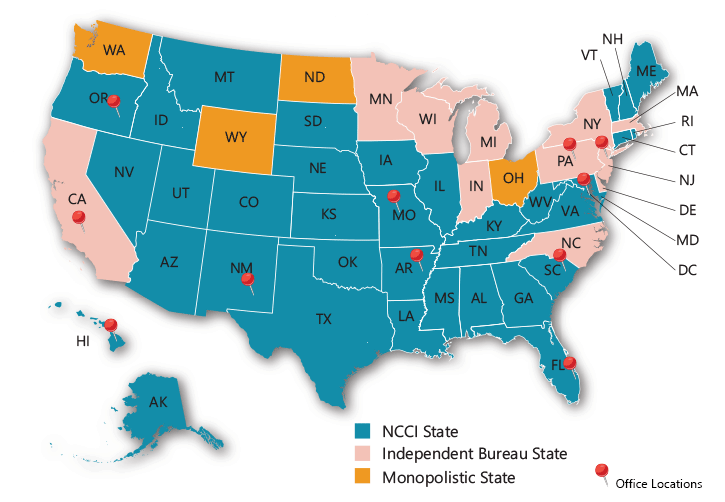
Remember, there are a handful of states that do
not use the NCCI classification
system: California, New Jersey, New York, Delaware, Massachusetts,
Michigan, Minnesota,
North Carolina, Pennsylvania and
Wisconsin are
states that have their own classification systems.
Texas until 2014
had their Department of Insurance operate independently of NCCI, but
Texas now has fully adopted NCCI classifications and manual
rules, subject to some "State Specials".
To see which states are
NCCI jurisdictions and which have independent rating bureaus,
consult our state-by-state
directory.
In general, the NCCI classification system seeks
to classify the overall
business enterprise
of an employer, not the particular
work performed
by specific
employees. For
that reason, a janitor working
at a manufacturing
plant will be
assigned to the overallmanufacturing
classification used
by that plant, not to
a janitorial classification.
The NCCI classification system makes
an exception to
this approach for construction-type
classifications. For these employers,multiple
classifications may
be assigned to employees, depending on the actual work done. But
work records must
show specific
hours at the
various tasks for a worker's time to
be split among
the appropriate classifications.
Even for non-construction employers, more
than a single
classification code is usually used on a policy, because the NCCI
has established that certain workplace exposures are almost
always eligible
to be broken
out into their
own classification--clerical,
outside sales, and
sometimes (but not always) drivers.
Determining what
the proper
classification code
is for a particular employer is not
always easy, even
for NCCI. AIM has helped a number of clients who were misclassified
into more expensive classes not just by their insurance company, but
by NCCI itself.
This is not so much a criticism of NCCI itself as it
is a reflection of the complexity of
the classification system.
Sometimes small
details can make a big difference in
which classification code is assigned to an employer, which in turn
can make a big difference in rates and premium.
In The Real World...
Who determines the classification codes used on an employer's
Workers Compensation insurance policy? It can be a bit of a
complicated process involving multiple parts of the insurance
system.
Consider all the various parties who may be
involved:
- The Insurance Agent/Broker - Workers
compensation class codes are often suggested by or
applied on the insurance application initially
by the insurance
producer who is selling workers compensation
insurance to the employer.
- The agent will typically ask
some questions of the employer to try and determine
exactly what operations the employer's business
performs.
- Typically the agent will look at past policies
of the employer for guidance. Then the agent/broker may
discuss things with an insurance company underwriter to
try and determine the correct class code for an
employer.
- But agents/brokers typically have widely
varying levels of experience and expertise in the fine
points of the classification system. The classification
system can be complicated and tricky and the best advice
of an insurance agent may sometimes be misleading or
misinformed. Most importantly, the agent's views on
classification do not bind the insurance company.
- The Insurance Company Underwriter - After
the insurance producer submits the workers compensation
application to the insurance company it will be reviewed
by an underwriter who may or may not agree with the
agent regarding the classifications--unless the Workers
Comp coverage is being placed in an Assigned Risk plan.
Initial underwriting in assigned risk plans is often
less than careful, which can set up the employer for
unpleasant surprises down the road.
- The Insurance Company's Auditor - After
the policy has ended and an audit is done by the
insurance company's auditor, the
auditor (or the auditor's manager) may make
changes in classifications--but these changes are made
after the policy has expired, which can produce a very
expensive and alarming "shock audit" where ultimate
costs of the coverage are far higher than the policy
itself would indicate.
- NCCI and other Rating Bureaus - NCCI
and other Rating Bureaus have the responsibility to
apply their own classification systems, sometimes overriding
underwriters and auditors at the insurance company.
- Sometimes these organizations are requested to perform
inspections to come up with an official classification
verdict for a particular employer when questions have
been raised. Remember that the
various states also maintain appeal systems that can
overturn a classification decision by a rating bureau
like NCCI.
The insurance industry doesn't make it easy for an employer to
figure out classifications rules, either. The insurance manuals
can be difficult to understand, or in some jurisdictions
relatively lacking in detail, even when an employer can get
access to them. Insurance jargon like NOC (Not
Otherwise Classified) or NPD (Non Premium
Divisible) can also make it difficult for an employer to
understand these insurance manuals. Consult our
glossary for definitions of these and
other terms.
There can be other complications that enter into the equation as
well. Each legal entity in a state is supposed to be separately
classified. And if there isn't a specific classification that
neatly fits an employer, then "classification by analogy" is
done, assigning the existing classification that seems to best
fit the employer's operations. Such situations often lead to
disputes between insurer and employer.
Because Workers Compensation insurance is, to a very great
extent, a state-by-state matter, not only can the classification
rules vary from one state to another, so too can the mechanisms
for disputing or appealing a classification decision by an
insurer or rating bureau.
AIM has experience helping clients in
all states that allow insurance for Workers
Compensation (and even in Ohio, which maintains a monopoly state
fund for Workers Compensation, but where the NCCI classification
system is now used.) So we are experienced in working with and
appealing classification decisions by NCCI and also by other
independent state systems, such as California, Delaware,
Pennsylvania, Michigan, New Jersey and New York.
Often, we find employers misclassified into
a more expensive classification for
years, in spite
of competitive bidding by various agents and insurers.
And
we've helped employers successfully appeal and reverse
classification decisions by NCCI and other rating bureaus.

We here at AIM are often
asked by
employers if they can find
details of this
NCCI classification system online.
The
answer, surprisingly, is no. Not
without paying NCCI for the privilege.
One
would think that such information would be publicly available
somewhere on the internet, as it is so fundamental to the pricing of
Workers Comp insurance. But NCCI views that manual, known as the Scopes
manual, as
proprietary and copyrighted material, which they
sell. So NCCI
doesn't want that material available freely.
To get that
information, one
must purchase a
copy of the manual from
NCCI, either a
hard copy or an electronic subscription.
An employer may be able to get information about specific
classification entries in the Scopes manual from their agent, but
not all agents have up-to-date copies of this manual.
Advanced Insurance Management LLC doesn't sell insurance.
Instead,
we consult with employers about proper Workers Compensation
insurance classifications, experience modifiers, payroll audits, and
other technical aspects that determine Workers Compensation
insurance premiums.
AIM helps employers successfully dispute classifications used by
insurance companies. We also provide expert witness services in
legal disputes with insurance companies over proper classifications,
rates, experience modifiers, and audit premium charges.
Find out if your employees have been misclassified by emailing
Advanced Insurance Management at aim@cutcomp.com.


 



Consultants on Workers Comp Classification Codes, Experience
Modifiers, Payroll Audits, & More
We've been helping employers since 1987, making
Advanced Insurance
Management one of the oldest and most experienced firms in the field
of premium recovery.
"Advanced Insurance Management has been a tremendous help to Allied
Welding, Inc., and has saved us money and generated a significant
refund on our Workers' Compensation by finding an error in our
classifications. We value their expertise."--Allied
Welding
|